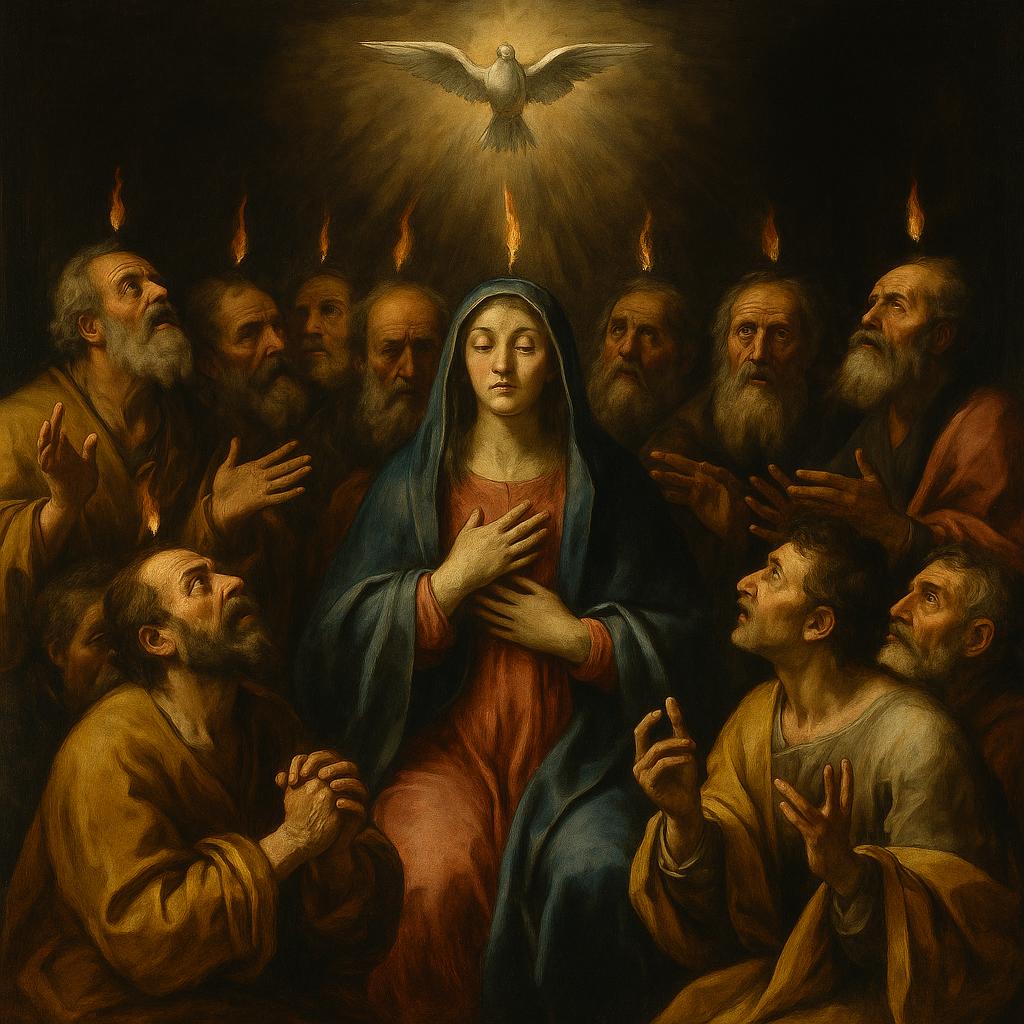
The Pentecost Sunday significance is deeply rooted in the Church’s understanding of the Holy Spirit’s descent and the birth of the Church. On Pentecost, 50 days after Easter, the Holy Spirit descended upon the apostles. Consequently, the apostles became bold witnesses of the Gospel. This event fulfills Christ’s promise to send the Paraclete and shapes the life of the Church to this day.
The Book of Acts describes Pentecost in detail. After Jesus spoke to his disciples, he ascended into heaven, ending his earthly mission. Consequently, the Holy Spirit descended upon the apostles, giving them the courage and wisdom to preach the Gospel. Moreover, this event marked the birth of the Church and the beginning of a new relationship with Jesus based on faith.
👉 Explore Acts 1: Bible Gateway
Pentecost has deep roots in the Old Covenant. Originally known as the Feast of Weeks or Shavuot, it was celebrated 50 days after Passover as a harvest festival. Additionally, it commemorated the giving of the Law at Sinai. In the New Covenant, this day became the moment when the Holy Spirit descended upon the apostles. Thus, they received the Spirit as tongues of fire, empowering them to proclaim the Gospel to all nations.
Pentecost is a solemn feast in the Roman Rite, marking the end of the Easter season. The Mass on Pentecost Sunday features ancient elements of Christian worship. For instance, vestments and altar cloths are red, symbolizing the fire of the Spirit and the blood of the martyrs.
The hymn “Veni Sancte Spiritus” is sung before the Gospel, invoking the Spirit’s gifts. Furthermore, the readings include the account from Acts 2, the Psalm “Lord, send out your Spirit,” and passages from 1 Corinthians 12 or Galatians 5. In the Extraordinary Form, Pentecost concludes with an Octave, an eight-day period of Masses and prayers that highlight the Spirit’s sanctifying power.
Throughout history, Pentecost has inspired beautiful customs. In Italy and France, red rose petals are dropped from church ceilings, symbolizing the tongues of fire. In Germany and other parts of Europe, Whitsun processions fill the streets with banners, chants, and Marian hymns.
Additionally, traditional confirmations often take place around Pentecost, reminding the faithful of the Spirit’s presence in the sacraments. In homes, families light red candles, recite the Litany of the Holy Spirit, and pray the Novena to the Holy Spirit—a practice that began with the apostles’ nine days of prayer before Pentecost.
Above all, Pentecost remains a powerful reminder of the Holy Spirit’s work in the Church today. The apostles, once afraid, became courageous witnesses to Christ. Today, that same Spirit guides the Church’s teaching, worship, and charitable works. In addition, the Spirit inspires personal devotion and prayer. Therefore, Pentecost is not merely a feast of the past but a living mystery—ancient and ever new.
Pentecost Sunday is more than a commemoration. It is a celebration of divine power and the Spirit’s ongoing presence in the Church. In every red vestment, every prayer of “Veni Sancte Spiritus,” and every flickering candle, the Church remembers not only what was given—but Who was given. The fire that descended in the Upper Room still burns wherever the Church prays, teaches, and sanctifies in the name of Christ.