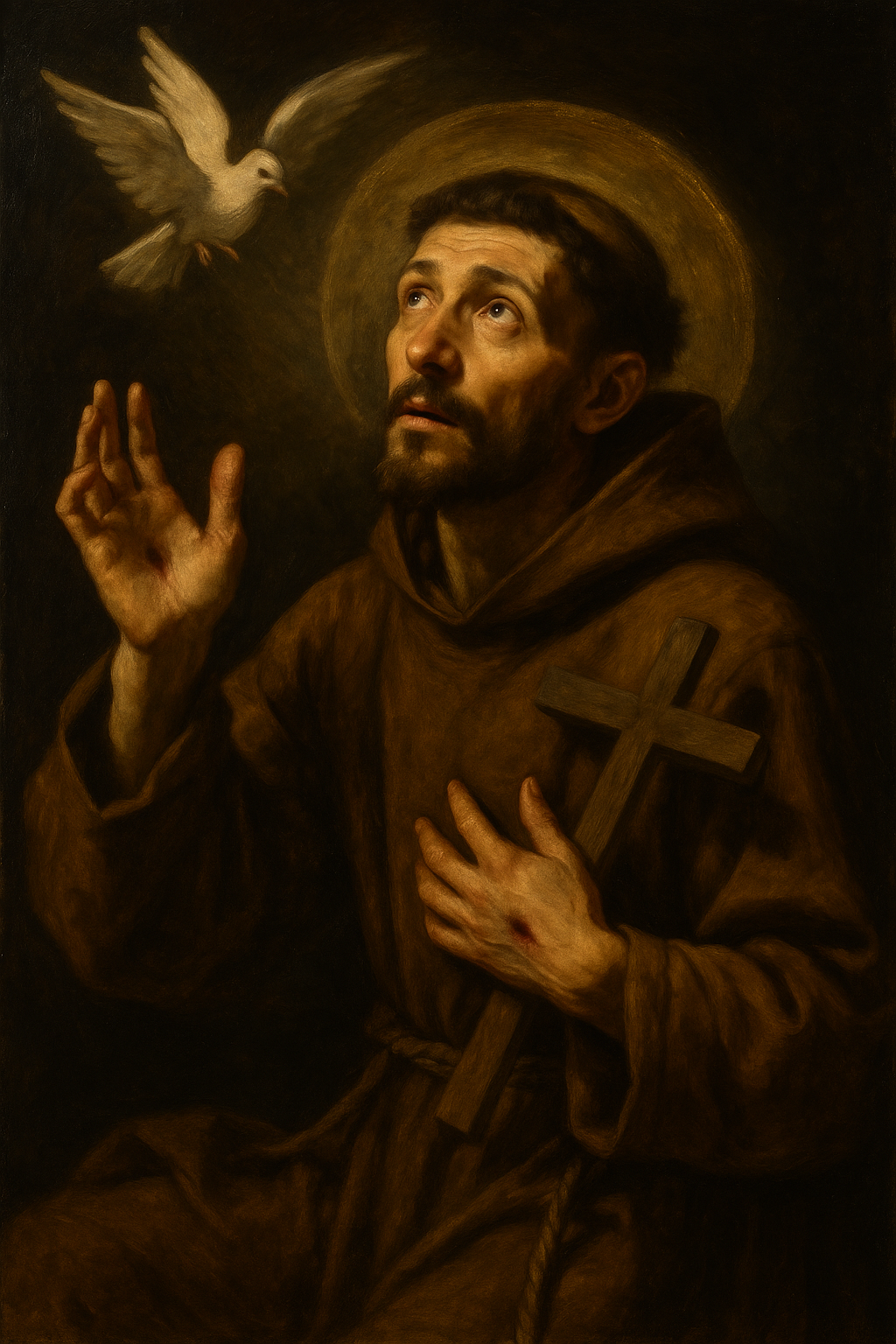
Saint Francis of Assisi was born Giovanni di Pietro di Bernardone in 1181 or 1182, in the small Italian town of Assisi. His father, a wealthy cloth merchant, expected Francis to inherit the family business and live a life of comfort. However, God had different plans. Francis grew up with a lively spirit, often leading the youth of Assisi in songs and celebrations. Though he enjoyed earthly pleasures, his heart longed for something greater.
His turning point came during a serious illness and later captivity as a soldier. These trials opened his soul to God’s call. Francis began to devote himself to prayer and works of mercy, slowly turning from worldly ambitions to the service of Christ.
The Call to Poverty and Conversion
One of the most decisive moments of his life occurred when he prayed before the crucifix in the dilapidated Church of San Damiano. There, he heard Christ say, “Francis, rebuild my Church, which you see is falling into ruin.” Taking these words literally at first, he set about repairing small churches with his own hands. Yet this call was deeper: Francis was to renew the Church spiritually.
Renouncing his inheritance, Francis stripped himself of all possessions before the bishop of Assisi, choosing instead a life of radical poverty. He became known as the Poverello, or “little poor man,” walking barefoot, dressed in a simple tunic, and relying only on God’s providence.
Founding the Franciscan Order
Francis’ witness quickly drew followers. Men inspired by his humility and joy joined him, forming what became the Order of Friars Minor, approved by Pope Innocent III in 1209. They lived by the Gospel, preaching repentance, serving the poor, and embracing absolute poverty.
Later, Saint Clare of Assisi, inspired by Francis, founded the Poor Clares, a contemplative Franciscan community for women. Together, these movements revitalized the Church, showing that holiness lies in simplicity, humility, and joyful obedience to God.
For further details on the Franciscan family, see the Order of Friars Minor.
Love for Creation and the Cross
Saint Francis is often remembered for his profound love of nature, calling the sun, moon, and creatures his brothers and sisters. His Canticle of the Creatures beautifully praises God through creation, reflecting his belief that all life points back to the Creator.
At the same time, Francis was deeply united to the suffering of Christ. In 1224, while praying on Mount La Verna, he received the stigmata, the wounds of Christ in his own body. This extraordinary grace confirmed his conformity to Christ Crucified.
Death and Canonization
Worn out by poverty, illness, and sacrifice, Francis died on October 3, 1226, singing psalms of joy. Just two years later, in 1228, Pope Gregory IX canonized him as a saint. The Basilica of Saint Francis in Assisi was built in his honor, housing his tomb and becoming a place of pilgrimage for centuries.
Conclusion
Saint Francis of Assisi, Confessor, continues to inspire the world with his radical embrace of poverty, humility, and love for God’s creation. His legacy lives on through the worldwide Franciscan family—friars, sisters, and laypeople—who follow his path of Gospel simplicity.
His feast day is celebrated on October 4, reminding the faithful that true freedom comes not from possessions, but from surrender to Christ. Saint Francis’ life remains a testimony that holiness is found in joyful humility and total trust in God.