Feast of St. Mary of Egypt: From Great Sinner to Great Saint

Introduction: A Story of Radical Conversion

Few saints show the power of God’s mercy as vividly as St. Mary of Egypt.
Once known for a life of sin and indulgence, she became one of the Church’s greatest models of repentance and transformation.
Her feast, celebrated on April 1 (and during the Fifth Sunday of Great Lent in the Eastern tradition), invites us to rediscover the truth that no soul is beyond redemption.

For American Catholics living in a culture that often normalizes sin or denies its reality, her story offers hope: conversion is always possible when grace is welcomed with humility.

The Life Before Grace

St. Mary was born in Egypt during the fifth century.
As a young woman, she abandoned her faith and pursued a life of passion and immorality, openly mocking the Christian virtue she once knew.
For seventeen years, she lived far from God, enslaved to worldly pleasure.

One day, she joined a group of pilgrims traveling to Jerusalem—at first not out of devotion, but curiosity.
However, when she tried to enter the Church of the Holy Sepulchre for the Feast of the Exaltation of the Cross, an invisible force prevented her from stepping inside.

At that moment, grace broke through her hardened heart.

🕊️ Transition tip: For context on her early life, see Catholic.org: St. Mary of Egypt.

The Moment of Conversion

Standing outside the church, Mary looked up and saw an icon of the Blessed Virgin Mary.
Overcome with sorrow, she begged Our Lady to intercede for her and vowed to renounce her sinful ways.
Immediately, she was able to enter the church and venerate the True Cross.
There she experienced deep repentance and divine forgiveness.

Afterward, she heard a voice calling her to cross the Jordan River and live in solitude.
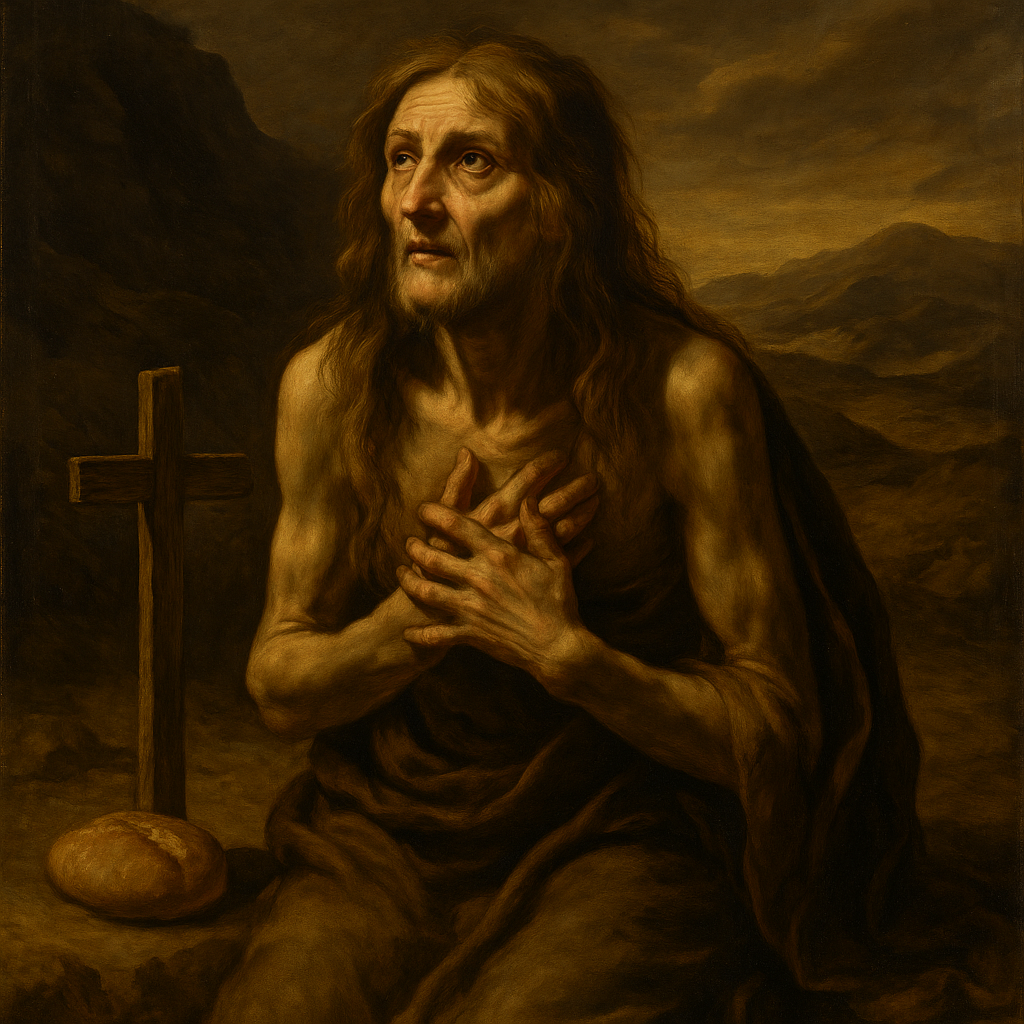
Obeying that call, she entered the desert—taking with her only three loaves of bread, her new faith, and an unshakable resolve to serve God alone.

Forty-Seven Years in the Desert

For nearly forty-seven years, Mary lived as a hermit in the harsh wilderness beyond the Jordan.
She endured hunger, thirst, heat, and temptation. Yet through constant prayer and fasting, her soul grew radiant in holiness.

Eventually, a priest named St. Zosimas of Palestine discovered her during Lent.
He found her clothed in rags, her skin darkened by the sun, but her heart shining with divine peace.
When Zosimas offered her Holy Communion, she received it with tears of joy.

One year later, he returned to find her lifeless body, marked by the sign of the cross.
It is said that lions came and helped him bury her—a sign of creation honoring the saint who had become new through grace.

🌿 Transition link: Read her full story in the Life of St. Mary of Egypt by St. Sophronius, Patriarch of Jerusalem (available through the Orthodox Church in America archive).

Theological Meaning of Her Conversion

St. Mary of Egypt’s story is not just historical—it’s profoundly theological.
She embodies the Church’s belief that repentance is a lifelong pilgrimage, not a single moment.
Through prayer, fasting, and penance, she entered spiritual union with God.

Her life shows that grace transforms nature.
What once was a soul lost in sin became a vessel of divine mercy.
Indeed, her radical conversion fulfills Christ’s words: “There will be more joy in heaven over one sinner who repents than over ninety-nine righteous persons.” (Luke 15:7)
What St. Mary of Egypt Teaches Modern Catholics

Modern life often downplays sin and dismisses the idea of repentance.
St. Mary of Egypt’s life confronts this false comfort. She teaches that true freedom is found not in indulgence but in surrender to God.
Her example invites every Catholic to examine the heart and seek renewal through the Sacrament of Confession.

Moreover, she reminds us that holiness is not reserved for the perfect but for the penitent.
Her feast day is a Lenten beacon—a reminder that God’s mercy reaches even the desert places of the soul.

Conclusion: Mercy Stronger Than Sin

The Feast of St. Mary of Egypt proclaims one of Christianity’s most beautiful truths: that God’s mercy can make saints from sinners.
Her life assures us that the road back to God, though steep, is always open.
In a time when many feel distant from faith, Mary’s story whispers a gentle truth: repentance is the door, and grace is already knocking.

May her witness inspire all believers to trust in the mercy of Christ, who makes all things new.

A Caravaggio-style painting of St. Mary of Egypt praying in the desert beside a small cross and loaf of bread, symbolizing repentance, fasting, and divine mercy.

Join Catholic Men of America today and enjoy more content like this plus networking and business opportunities!