Friday of Sorrows: Feast of the Seven Sorrows of Mary

Introduction: A Mother’s Suffering and a Savior’s Love

In the week before Holy Week, the Church pauses to honor the deep compassion of the Blessed Virgin Mary.
Friday of Sorrows, traditionally observed on the Friday before Palm Sunday, is also known as the Feast of the Seven Sorrows of the Blessed Virgin Mary.

This ancient devotion helps Catholics meditate on the sufferings Mary endured in union with her Son.
Her sorrows were not signs of despair but of love—a love that stayed faithful even at the Cross.
For American Catholics preparing for Holy Week, this feast offers a quiet, powerful reminder: to love Christ deeply is to share in His Cross.

The Origins of the Feast

The devotion to the Seven Sorrows of Mary began in the 13th century with the Servite Order (the Servants of Mary).
They promoted reflection on Mary’s suffering as a path to compassion and conversion.
In 1727, Pope Pius VII extended the feast to the universal Church, encouraging all the faithful to honor Mary’s participation in the Passion of her Son.

Through this feast, the Church reminds us that Mary’s suffering was not passive.
Rather, she united her pain with Christ’s redemptive mission, standing as the perfect model of faith under trial.

🕊️ Transition tip: Learn more about the Servite devotion at New Advent: Servite Order

The Seven Sorrows of the Blessed Virgin Mary

The devotion centers on seven key moments of sorrow in Mary’s life—each one piercing her heart as foretold by Simeon (Luke 2:35):

  1. The Prophecy of Simeon (Luke 2:25–35)

  2. The Flight into Egypt (Matthew 2:13–15)

  3. The Loss of the Child Jesus in the Temple (Luke 2:41–50)

  4. Mary Meets Jesus Carrying the Cross (Luke 23:27–31)

  5. The Crucifixion and Death of Jesus (John 19:25–30)

  6. The Body of Jesus Placed in Mary’s Arms (Luke 23:50–54)

  7. The Burial of Jesus (Luke 23:55–56)

Each sorrow invites us to reflect on our own trials.
Mary shows us how to face them—not with bitterness, but with faith and surrender.

The Meaning of Her Sorrows

Mary’s sorrows were not isolated moments of grief; they were acts of love united to Christ’s suffering.
At each stage, she accepted God’s will completely, offering her pain for the salvation of souls.
Her suffering reveals the heart of true compassion—to suffer with and for others in love.

Indeed, Mary’s example reminds us that sorrow, when united with Christ, becomes redemptive.
As Pope Pius XII wrote, “Mary suffered and almost died with her suffering Son… she offered Him to the justice of God.”

🌹 Transition link: Reflect on Mary’s compassion with the Seven Sorrows Rosary devotion.

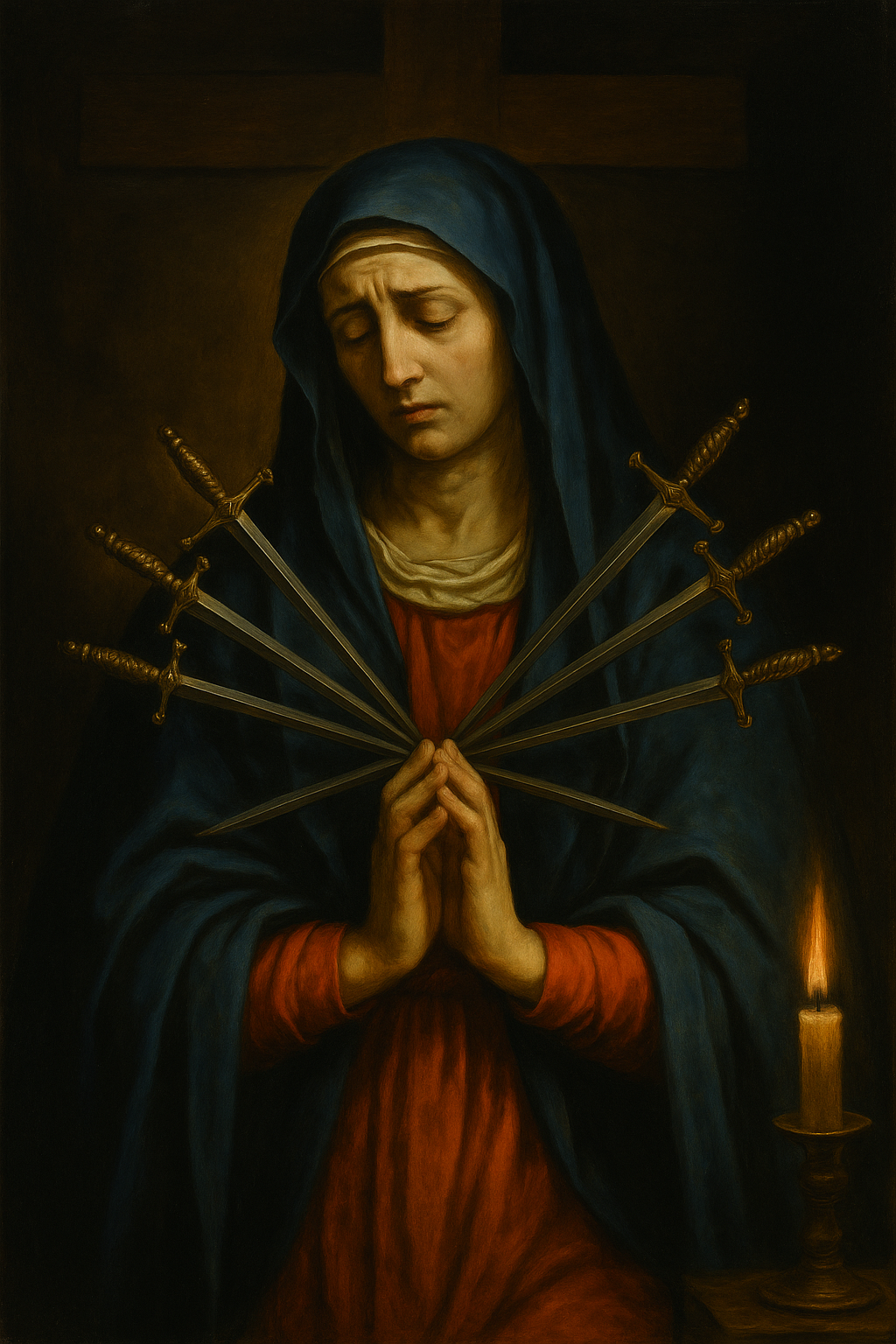
The Symbolism of the Seven Swords

In sacred art, Mary is often shown with seven swords piercing her heart, representing her sorrows.
This imagery comes from Simeon’s prophecy and symbolizes the depth of her maternal love and pain.

Each sword reminds the faithful that love costs something.
Mary’s heart was pierced not because she lacked faith, but because she loved perfectly.
Her compassion reveals the mystery that suffering can coexist with peace when offered to God.
Why This Feast Matters for Today

In our fast-paced and comfort-driven culture, the Feast of the Seven Sorrows teaches the beauty of compassion and endurance.
It encourages Catholics to unite their own sufferings with Mary’s, finding meaning in what the world often rejects—sacrifice.

Her example invites us to comfort others, to stand beside those who suffer, and to trust that God transforms pain into redemption.
When we meditate on her sorrows, we learn to say with Mary: “Be it done unto me according to thy word.”

Conclusion: Standing with Mary at the Cross

The Friday of Sorrows prepares the heart for the coming Passion.
By walking with Mary through her sorrows, we learn to stay near Jesus in His suffering.
Her tears mirror God’s mercy; her silence echoes perfect trust.

In honoring her Seven Sorrows, the Church reminds us that love and suffering are inseparable—and that both lead to resurrection.
As Lent nears its climax, may we stand beside Mary at the Cross, sharing her faith, her sorrow, and her hope.

A Caravaggio-style painting of the Virgin Mary with seven swords piercing her heart, standing at the foot of the Cross, symbolizing her sorrow, compassion, and unwavering faith.

Join Catholic Men of America today and enjoy more content like this plus networking and business opportunities!