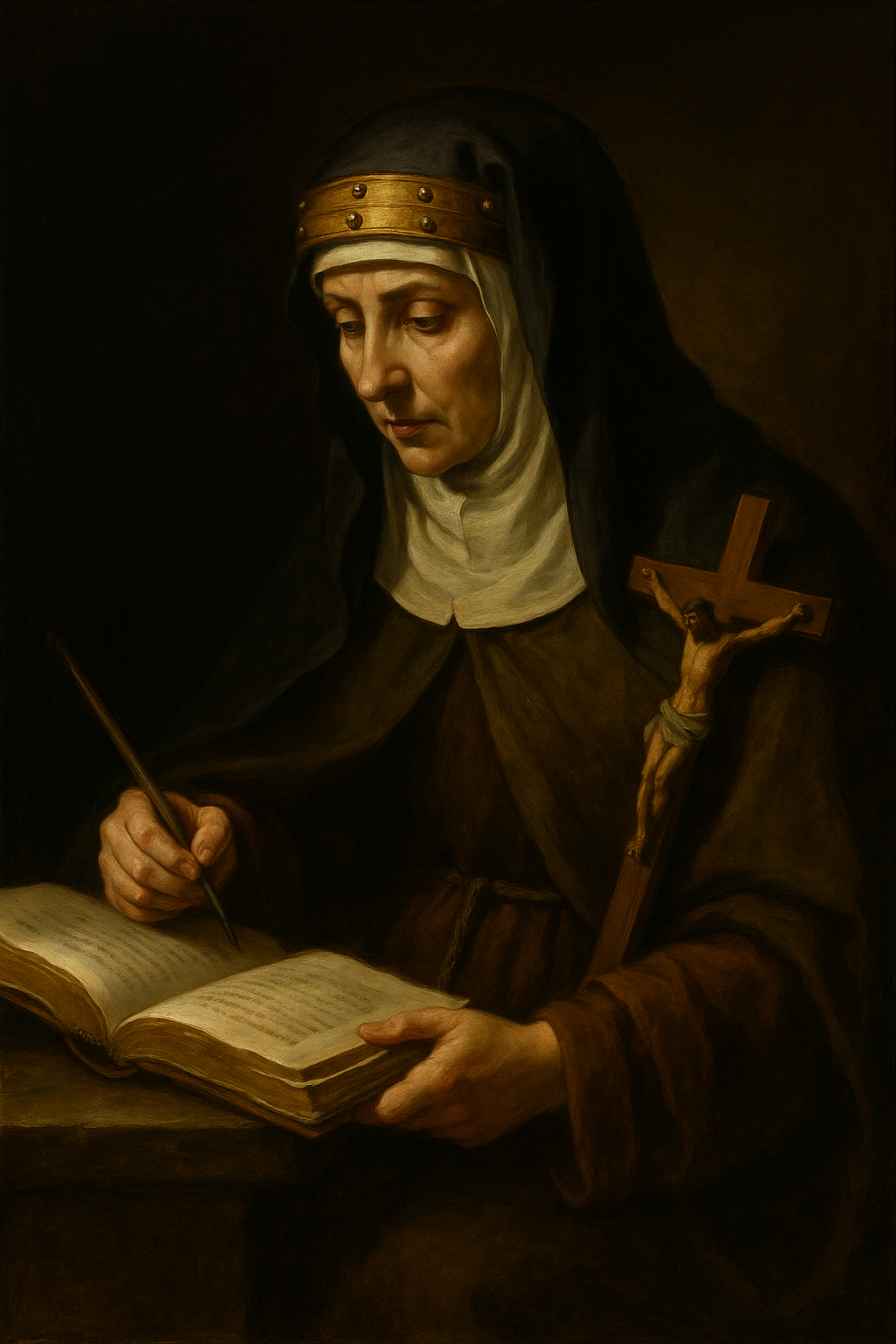
Saint Bridget was born in 1303 in Uppsala, Sweden, into a noble and devout family. From childhood she received mystical graces, including visions of Christ Crucified. Her parents nurtured her faith, and she grew into a woman of deep prayer and generosity.
At just thirteen, Bridget married Ulf Gudmarsson, a nobleman of great reputation. Their marriage, marked by fidelity and devotion, produced eight children, including Saint Catherine of Sweden. Moreover, Bridget lived her vocation as wife and mother with holiness, balancing noble duties with care for the poor.
Widowhood and Deeper Conversion
After twenty-eight years of marriage, Ulf died on the return from a pilgrimage to Santiago de Compostela. As a widow, Bridget chose to dedicate her life entirely to God. She embraced prayer, fasting, and works of mercy with renewed intensity.
Her widowhood opened a new chapter of service. Rather than withdraw into seclusion, she became a counselor to rulers and a spiritual guide to clergy. Therefore, her influence extended far beyond her homeland of Sweden.
Mystical Visions and Prophetic Voice
Throughout her life, Bridget received extraordinary mystical revelations. These visions, later collected as the Revelations of Saint Bridget, included reflections on the Passion of Christ, the Blessed Virgin Mary, and heavenly realities. Furthermore, her writings shaped Christian devotion across Europe for centuries.
Her prophetic voice carried weight among rulers, popes, and common people. She urged kings and queens to govern justly and called the Church to reform. Indeed, her courage and fidelity made her a spiritual mother to the Christian world.
For more on her writings, see the Revelations of Saint Bridget
Founding of the Bridgettine Order
Guided by divine inspiration, Bridget established the Order of the Most Holy Savior, known as the Bridgettines. The order combined monastic prayer with hospitality and service. Men and women lived in the same community under the leadership of an abbess.
This vision reflected her understanding of the Church as a family under Christ and Mary. In addition, the order became known for its devotion to the Passion of Christ and its spirit of simplicity.
Pilgrimage to Rome and Final Years
In 1349, Bridget journeyed to Rome to seek papal approval for her order. She spent the last decades of her life there, working tirelessly for the renewal of Christian life. Moreover, she encouraged Pope Urban V to return the papacy from Avignon to Rome.
Bridget died in Rome on July 23, 1373. Her body was later brought back to Sweden, where she was honored as a national and spiritual mother. Pope Boniface IX canonized her in 1391, and in 1999 Saint John Paul II named her one of the patron saints of Europe.
Conclusion
The life of Saint Bridget of Sweden, Widow, shines as a witness to holiness in every state of life. She lived faithfully as spouse, mother, widow, and religious founder. Her mystical writings still invite the faithful to meditate on the Passion of Christ.
Her feast on July 23 calls Christians to greater prayer, courage, and love for the Church. Indeed, her legacy endures in the Bridgettine Order and in the countless souls inspired by her example of faith and fidelity.