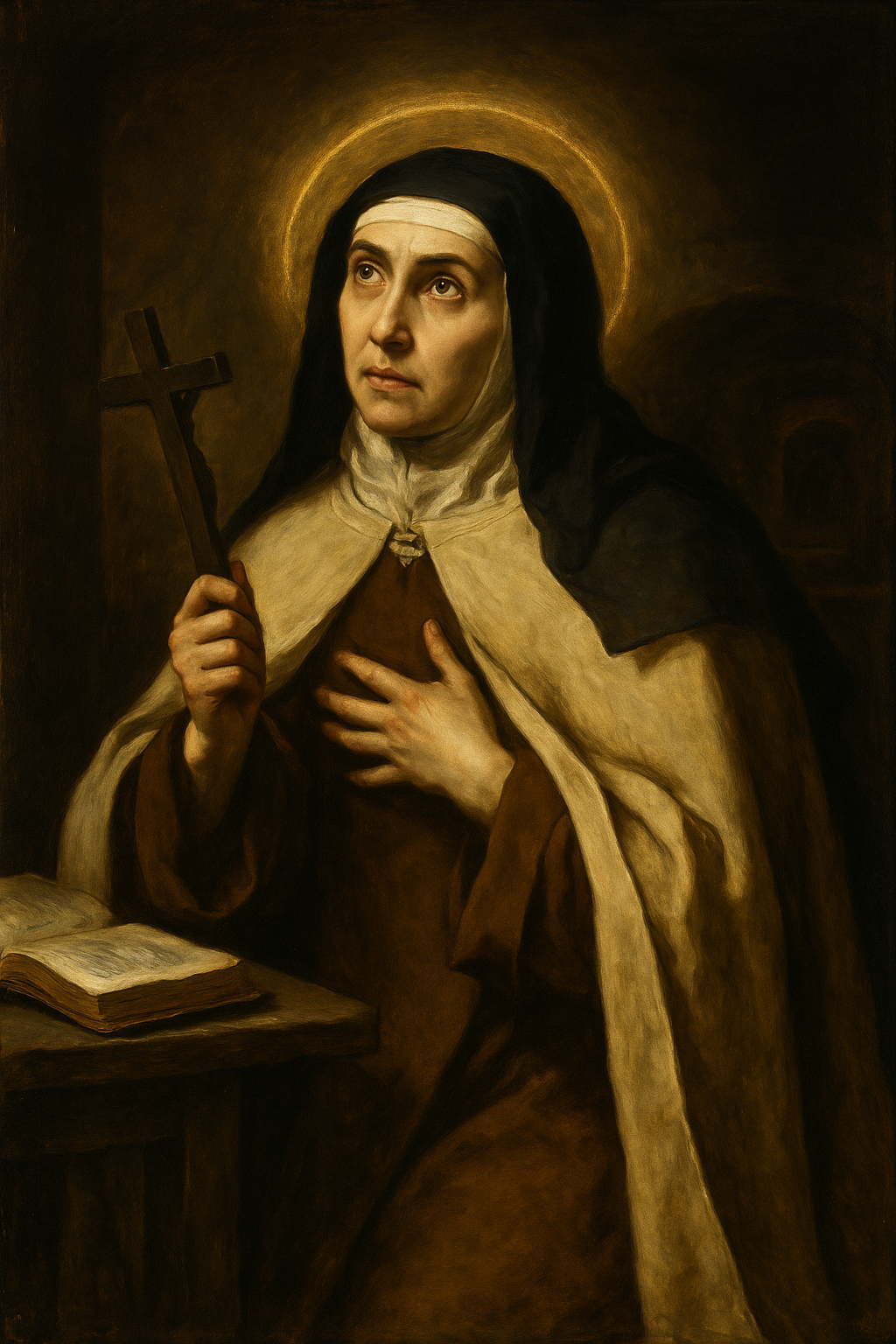
Saint Teresa of Avila, also known as Saint Teresa of Jesus, stands as one of the great mystics and reformers of the Catholic Church. Born in 1515 in Avila, Spain, she dedicated her life to deep prayer, courageous reform, and the renewal of religious life. Canonized in 1622 and later declared a Doctor of the Church in 1970, she remains a guiding light for those seeking holiness and union with God.
For an overview of her life, see the Wikipedia entry on Teresa of Ávila.
Early Life and Religious Vocation
Teresa came from a noble Spanish family and received her first formation in faith from her parents. Drawn to prayer from a young age, she entered the Carmelite Convent of the Incarnation in Avila at age 20. Yet her early years in religious life were marked by struggles, distractions, and illness. Despite these difficulties, she pursued God with determination, eventually experiencing profound spiritual conversion and mystical union with Christ.
The Reform of the Carmelites
By the mid-1500s, Teresa recognized the need to restore the Carmelite Order to greater simplicity and fidelity. With courage and perseverance, she founded the Discalced Carmelites, emphasizing poverty, silence, and contemplative prayer. Her reform movement met resistance, yet she remained steadfast, always seeking God’s will. Through her efforts, new convents arose that reflected the original spirit of Carmel, dedicated to prayer and holiness.
For more about her reform, see the Catholic Encyclopedia on Teresa of Avila
Mystic and Teacher of Prayer
Saint Teresa’s legacy reaches beyond her reform to her mystical writings, which continue to nourish the Church today. Her works, such as The Interior Castle and The Way of Perfection, explore the soul’s journey toward union with God through prayer, detachment, and love. She described prayer not as mere words but as a deep friendship with Christ. Her vivid images and practical guidance make her one of the greatest teachers of the spiritual life.
Doctor of the Church
In 1970, Pope Saint Paul VI proclaimed Teresa a Doctor of the Church, recognizing her outstanding contribution to Catholic spirituality and theology. She was the first woman to receive this title, a testament to her profound wisdom and the universality of her teaching. Her writings offer guidance not only to religious but also to lay people seeking a deeper relationship with God.
Conclusion
Saint Teresa of Avila’s life combines mysticism, reform, and courage in the face of difficulty. She shows that holiness is not reserved for the few but is possible for all who persevere in prayer and charity. Celebrated on October 15th, her feast invites the faithful to enter more deeply into the mystery of prayer and to trust, as she did, in God’s unfailing love.
To learn more about her feast and writings, visit Catholic.org’s page on Saint Teresa of Avila.