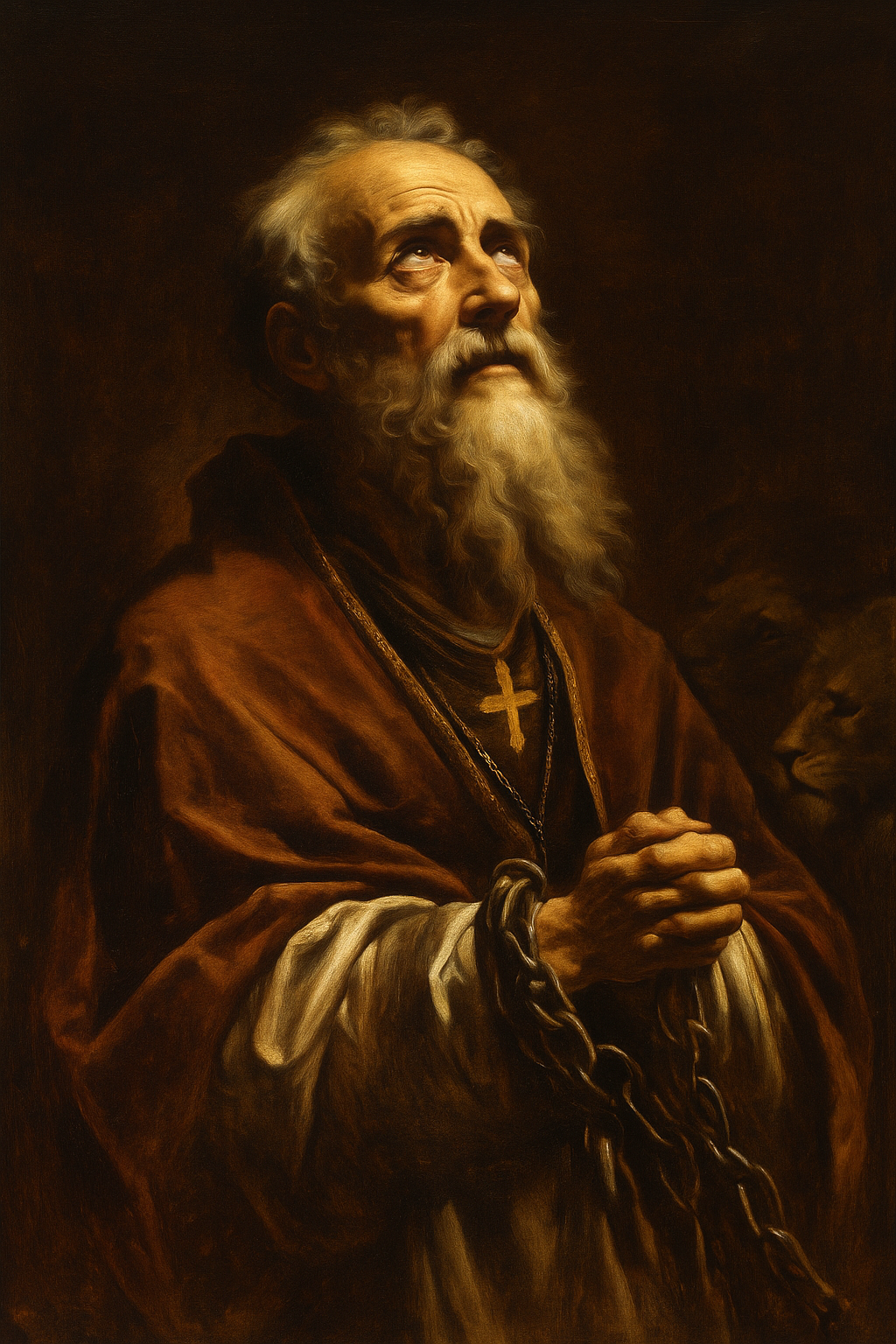
Saint Ignatius of Antioch, known as Theophorus or “God-bearer,” stands among the greatest leaders of the early Church. Born in Syria around 35 AD, he became a disciple of Saint John the Apostle. Later, he succeeded Saint Peter as the third Bishop of Antioch.
During his ministry, persecution raged under the Roman Empire. Yet Ignatius led his flock with courage and deep faith. He taught believers to stay united with their bishops and to hold firmly to the true faith of Christ. His love for the Lord and the Church became most evident in the final journey of his life.
Journey to Martyrdom in Rome
Around 107 AD, during Emperor Trajan’s rule, Roman officials arrested Ignatius for refusing to deny Christ. Bound in chains, he was taken from Antioch to Rome to face death in the Colosseum. Along this journey, he wrote seven remarkable letters addressed to the Christian communities in Ephesus, Magnesia, Tralles, Rome, Philadelphia, Smyrna, and to Saint Polycarp.
These letters reveal a heart burning with love for Jesus and a profound sense of Church unity. He encouraged believers to remain faithful to the Eucharist and their bishops. As he neared martyrdom, he wrote to the Christians in Rome, pleading:
“I am God’s wheat, and I shall be ground by the teeth of beasts to become the pure bread of Christ.”
Teachings on the Eucharist and Church Unity
Saint Ignatius gave one of the earliest and clearest teachings on the Real Presence of Christ in the Eucharist. He warned against those who denied this mystery, affirming that the Eucharist is truly the Body and Blood of the Lord.
He also stressed that unity within the Church depends on the faithful’s communion with their bishop. To him, the bishop represented Christ in every community. These insights helped shape Catholic understanding of the Church’s structure and sacramental life, bridging the time between the Apostles and future generations.
Martyrdom in the Colosseum
When Ignatius reached Rome, he faced execution by wild beasts in the Colosseum. Despite the horror of his fate, he accepted it as a sacred offering to God. The faithful later recovered his relics and brought them back to Antioch, where they became objects of deep veneration.
His death was not a defeat but a triumph—love overcoming fear and faith conquering death. His martyrdom inspired many to stand firm in Christ amid persecution.
Conclusion
Saint Ignatius of Antioch remains a luminous figure in Church history. His writings continue to inspire faith and devotion, especially regarding the Eucharist, Church authority, and unity among believers. The Church celebrates his feast on October 17.
His final words, “Let me imitate the passion of my God,” echo the essence of Christian discipleship. His witness reminds us that true faith calls for both love and sacrifice—a heart willing to follow Christ, even unto death.
To learn more about Saint Ignatius of Antioch, visit: