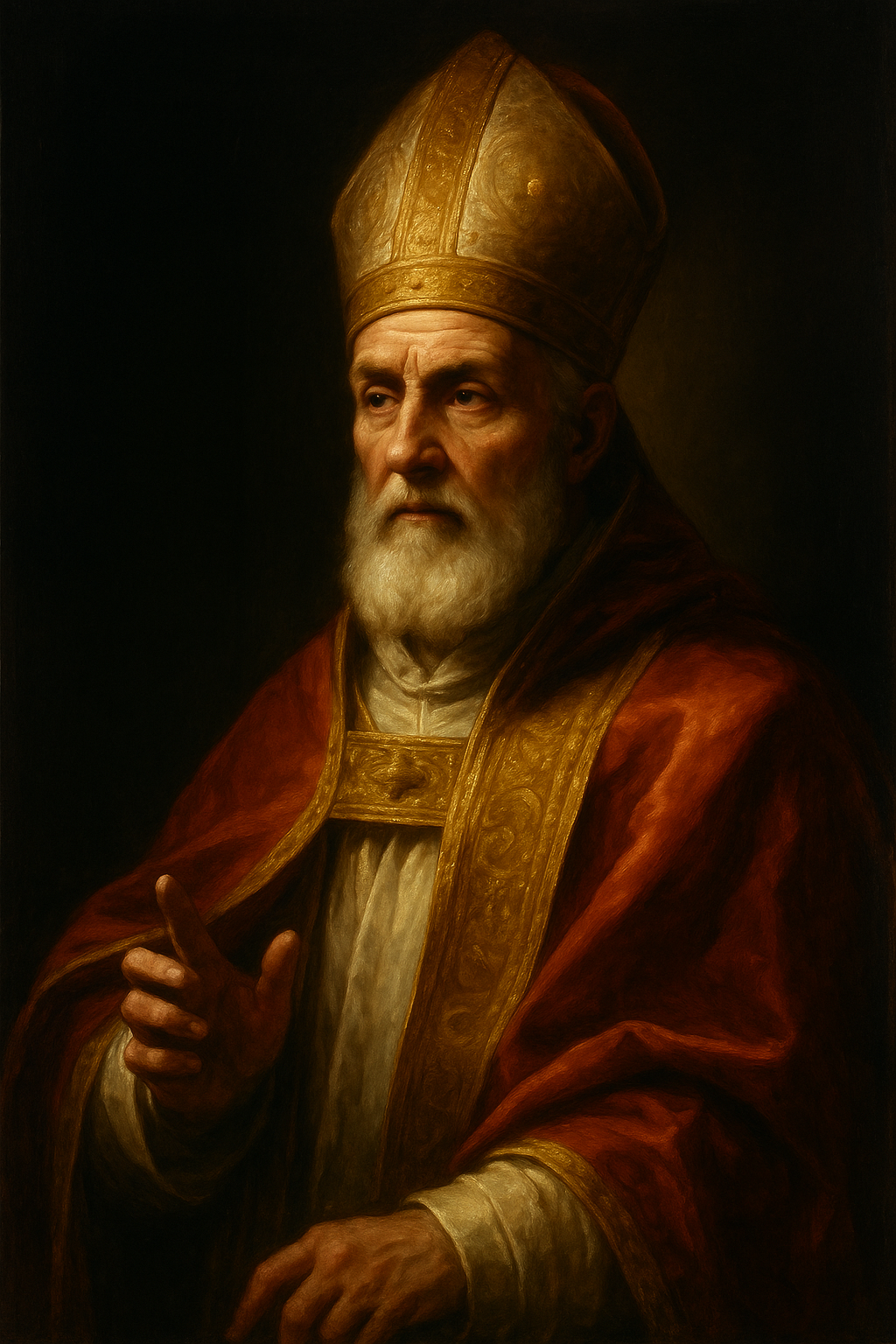
Saint Leo the Great, Pope and Doctor of the Church, stands among the most influential leaders in Christian history. Renowned for his theological brilliance and pastoral courage, he guided the Church through turbulent times with unwavering faith and divine wisdom. His papacy preserved the unity of the Church and clarified essential truths about Christ and His saving mission.
Early Life and Rise to the Papacy
Saint Leo was born in Tuscany, Italy, around the year 400 AD. Known for his intelligence and prudence, he served as a deacon under Pope Celestine I and became an advisor to successive pontiffs. His reputation for holiness and leadership led to his election as Pope in 440 AD.
From the beginning, Leo understood the papacy as a sacred duty to preserve truth and protect the flock of Christ. His motto could well have been: “The care of all the Churches is my care.”
To learn more about his early years, visit Wikipedia – Pope Leo I.
Defender of the Faith Against Heresy
During Leo’s time, false teachings threatened the purity of Christian doctrine. Most notably, he confronted the Eutychian heresy, which denied the two natures of Christ—divine and human. In response, Leo wrote his famous “Tome of Leo”, a masterful theological document explaining the true faith.
This letter was later read at the Council of Chalcedon in 451 AD, where the assembled bishops acclaimed:
“Peter has spoken through Leo!”
His defense of Christ’s full divinity and humanity became a cornerstone of Catholic theology and earned him the title Doctor of the Church.
You can explore the Tome of Leo and its historical significance at the Vatican website.
Shepherd and Protector of the Church
Saint Leo’s greatness was not only in his words but also in his deeds. In 452 AD, when the barbarian leader Attila the Hun advanced toward Rome, Leo met him face to face. Through his courage and divine persuasion, Attila turned away and spared the city.
A few years later, in 455 AD, Leo confronted the Vandals during their invasion of Rome. Though unable to prevent the attack entirely, he successfully pleaded for mercy, saving many lives and churches from destruction.
These acts revealed a shepherd who protected his flock not only with doctrine but also with fearless compassion.
Theological Vision and Legacy
Pope Leo viewed his papal ministry as the continuation of Saint Peter’s mission. He emphasized that the Pope, as the successor of Peter, must guide the universal Church in faith and unity.
His homilies and writings remain treasures of Catholic theology. He spoke beautifully of the Incarnation, the Eucharist, and the dignity of Christian life, teaching that salvation is God’s work of love made visible in Christ.
His statement still inspires believers today:
“Christian, remember your dignity, and now that you share in God’s nature, do not return to your former base condition.”
Death and Canonization
Saint Leo the Great died on November 10, 461 AD, after twenty-one years of faithful service as Pope. His relics rest in St. Peter’s Basilica in Rome. In recognition of his sanctity and doctrine, he was declared a Doctor of the Church in 1754 by Pope Benedict XIV.
His feast is celebrated on November 10, the same day as Saint Andrew Avellino, honoring both his theological wisdom and his pastoral zeal.
Conclusion
Saint Leo the Great stands as a shining model of faith, courage, and intellect. His words shaped the Church’s understanding of Christ; his deeds preserved the peace and dignity of Rome. As both Pope and Doctor, he reminds every Christian that truth and charity must always walk together.
“He who believes in the Incarnation of the Lord cannot doubt His mercy.”
Through his intercession, may the Church remain steadfast in faith and fearless in love.