Palm Sunday: The King Who Enters in Humility

Introduction: The Doorway to Holy Week

Palm Sunday marks the beginning of Holy Week, the most sacred time in the Christian calendar.
It commemorates Jesus’ triumphal entry into Jerusalem, when the crowds waved palm branches and shouted “Hosanna!” to welcome Him as King.
Yet, within days, those same voices would cry, “Crucify Him.”

For Catholics, Palm Sunday is both joyful and sorrowful—a reminder that glory and suffering are inseparable in the mystery of salvation.
The palms we hold in our hands symbolize victory through sacrifice and prepare our hearts to follow Christ through His Passion.

The Scriptural Foundation

The story of Palm Sunday appears in all four Gospels (Matthew 21, Mark 11, Luke 19, and John 12).
Jesus enters Jerusalem riding on a donkey, fulfilling the prophecy of Zechariah:
“Behold, your King is coming to you; humble, and mounted on a donkey.” (Zechariah 9:9)

The people spread cloaks and palm branches on the road, proclaiming Him as the Son of David.
This moment reveals the paradox of the Gospel: the true King conquers not by force but by humility.
Christ enters not to seize power but to offer Himself in love.

🕊️ Transition tip: Read the full account in Matthew 21:1–11

The Meaning of the Palms

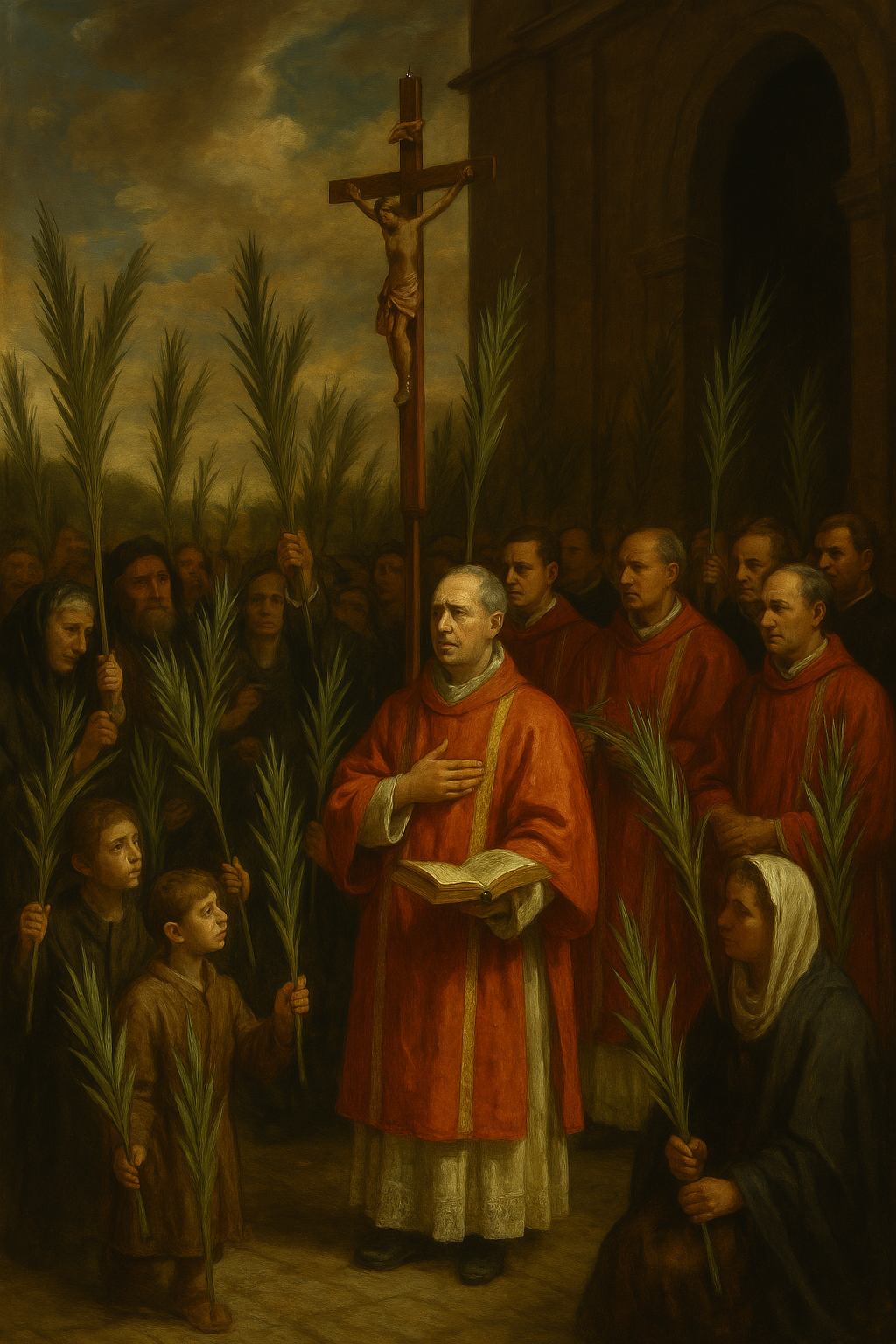
The palm branch has long been a symbol of victory, peace, and eternal life.
In ancient times, victors of battle or competition were honored with palms.
On Palm Sunday, the Church reclaims this symbol to celebrate Christ’s victory over sin and death.

During the procession, the faithful hold palms high and sing “Hosanna!”—a Hebrew word meaning “Save us, Lord!”
These blessed palms are later kept in homes as sacramentals and burned the following year to make ashes for Ash Wednesday.
Thus, the palm becomes a living sign that joy and repentance belong together.

The Dual Nature of the Liturgy

Palm Sunday has a twofold character: triumph and Passion.
It begins with a procession of praise and ends with the reading of the Passion from the Gospels.
This shift reflects the dramatic contrast of Holy Week:
the crowd that hailed Jesus as King soon turns against Him.

The Church invites the faithful to see themselves in that crowd—sometimes loyal, sometimes forgetful.
By hearing the Passion aloud, Catholics are drawn into the mystery personally.
We are not spectators of history but participants in redemption.

🌿 Transition link: Explore the readings for Palm Sunday at the USCCB Daily Readings

The Humility of the King

Palm Sunday teaches that true kingship is found in humility.
Jesus chose not a warhorse but a donkey—the mount of peace.
He did not enter Jerusalem to overthrow Rome but to conquer sin by the Cross.

His power lies in love, His throne is the wood of the Cross, and His crown is woven with thorns.
In this, He reveals that God’s glory shines brightest through self-sacrifice.
As St. Augustine wrote, “The Lord entered the city where He was to suffer, not to rule.”
The Call to Follow Christ

Palm Sunday calls every Christian to follow Christ through both Hosanna and crucifixion.
Faith cannot stop at admiration; it must lead to imitation.
We are called to walk beside Him through the Passion, trusting that His way of humility leads to resurrection.

Moreover, the blessed palms we carry are not decorations—they are invitations.
They remind us to let Christ reign not just in ceremonies but in our hearts, words, and actions.
To hold a palm is to proclaim: “I belong to the King who serves.”

Conclusion: From Palms to Passion

Palm Sunday opens the gates of Holy Week and leads us to Calvary.
The joy of Jerusalem’s welcome quickly turns into the silence of the Cross.
Yet within that journey lies the mystery of redemption: through suffering comes glory, and through death comes life.

As we raise our palms, we echo the cry of every generation:
“Hosanna! Blessed is He who comes in the name of the Lord!”
And as we listen to His Passion, we begin to understand the depth of those words.

Discover the meaning of Palm Sunday, when Jesus entered Jerusalem as King. Learn its history, symbols, and message of humility before Holy Week.

Join Catholic Men of America today and enjoy more content like this plus networking and business opportunities!