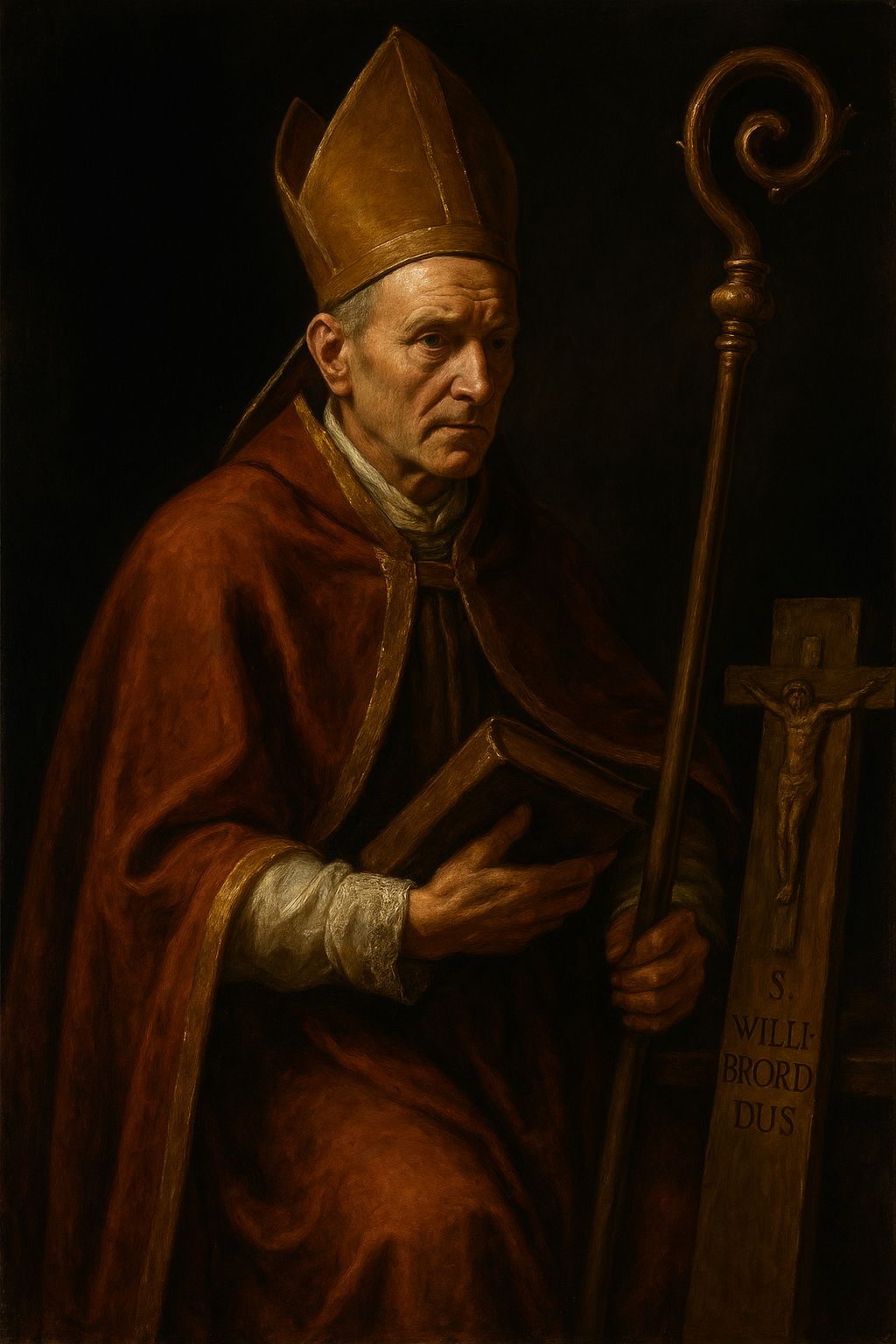
Saint Willibrord, Bishop and Confessor, is remembered as the Apostle to the Frisians. He was a courageous missionary who brought the light of Christ to northern Europe. With great perseverance, he spread the Gospel, established churches, and became the first Bishop of Utrecht. His efforts prepared the ground for Christianity in the Netherlands, Luxembourg, and parts of Germany.
Early Life and Formation
Willibrord was born around 658 AD in Northumbria, England. At a young age, his parents entrusted him to the monastery of Ripon, where he studied under Saint Wilfrid. Later, seeking deeper discipline, he traveled to Ireland and joined the monastery of Rathmelsigi under Saint Egbert.
This strict formation gave him humility, obedience, and courage. These virtues shaped his heart for the missionary journey that God would soon ask of him.
Mission to the Frisians
In 690 AD, Willibrord set out with eleven companions for Frisia (modern Netherlands and northern Germany). The region was still pagan, yet he approached the people with patience and kindness. His preaching touched hearts, and many accepted baptism.
To strengthen his mission, he traveled to Rome. Pope Sergius I gave him official support and entrusted him with the work of evangelization. Encouraged, Willibrord returned and continued to preach, build churches, and form Christian communities.
Bishop of Utrecht
In 695 AD, Pope Sergius I consecrated Willibrord as the first Bishop of Utrecht. He also gave him the pallium, symbol of his authority as metropolitan archbishop. From Utrecht, Willibrord guided the new flock and expanded his mission across Frisia.
He also founded monasteries, most notably the Abbey of Echternach in Luxembourg. This abbey became a center of prayer and missionary outreach, ensuring that the faith would grow stronger in the region.
Legacy of Evangelization
Saint Willibrord’s missionary work was not easy. He faced pagan opposition and endured physical hardships. Nevertheless, he never lost hope. His perseverance inspired future missionaries, including Saint Boniface, who carried the Gospel deeper into Germany.
Today, Willibrord is honored as the patron saint of the Netherlands and Luxembourg. He died on November 7, 739, at Echternach, where his relics are still venerated. His feast day remains a celebration of missionary zeal and faith.
Conclusion
Saint Willibrord, Bishop and Confessor, stands as a model of courage and faith. As the Apostle to the Frisians, he showed how the Gospel takes root through prayer, sacrifice, and steady witness. His life reminds us that the Church grows not by force, but by love and perseverance.
To learn more about his life, visit the Wikipedia page on Saint Willibrord.
For more historical detail, see the Catholic Encyclopedia entry on Saint Willibrord.
Did you enjoy this article? Share it with your friends and family!