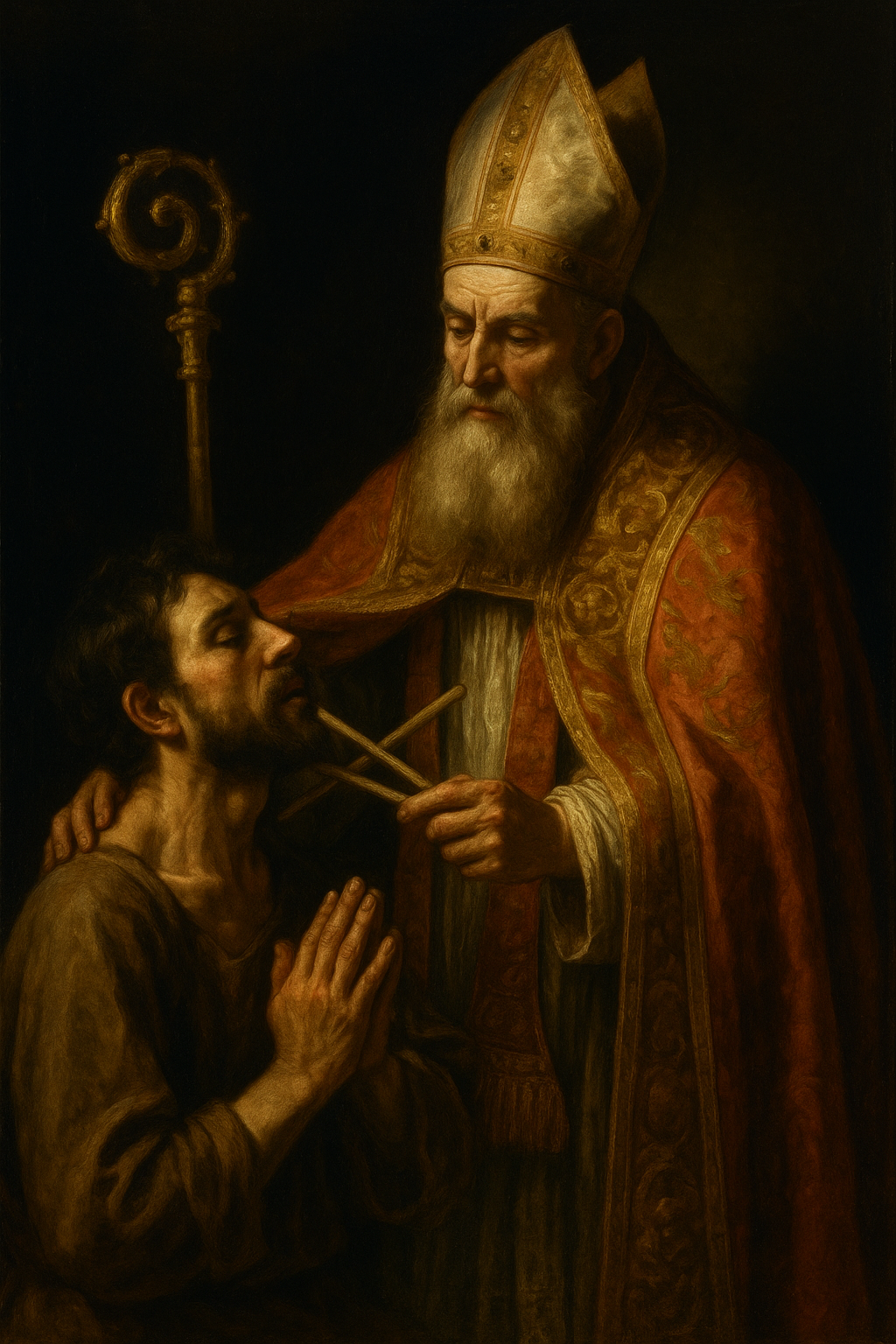
On February 3rd, the Catholic Church commemorates St. Blaise, a revered bishop and martyr of the early Church. While his life is steeped in ancient tradition and some legend, his feast day is particularly known for the blessing of throats. This cherished ritual, therefore, distinguishes his observance. It often raises questions about its true meaning: Is it superstition, or something far more profound? The Church clearly teaches that the Blessing of St. Blaise is a sacramental, a powerful intercession for health, certainly not a superstitious charm.
Saint Blaise lived during the 3rd and 4th centuries. He served as the Bishop of Sebaste in Armenia. Tradition, moreover, recounts him as a skilled physician before his episcopacy. He was widely known for his deep piety, compassion, and miraculous cures, even among animals. During the persecutions under Roman Emperor Licinius, Blaise was arrested. However, he bravely refused to renounce his Christian faith. Consequently, he endured brutal torture and was ultimately martyred, beheaded for his unwavering conviction. His life, therefore, embodies both dedicated service and courageous witness to Christ and the Catholic faith.
The most famous story associated with St. Blaise and the origin of the throat blessing tradition centers on a miraculous event. While Blaise was being led to prison, for instance, a desperate mother approached him. Her child was choking on a fishbone and was near death. Blaise, despite his own immense suffering, compassionately prayed over the child. Miraculously, the child was cured. This act of compassionate healing, therefore, solidified his patronage against throat diseases. Thus, the Church formalized this intercession into the special Blessing of St. Blaise, performed annually on his feast day. It serves as a powerful reminder of his sanctity and God’s healing power through him.
The Blessing of Throats is a unique and visible custom. Typically, two blessed candles, held in a V-shape, are placed around a person’s throat while a prayer is recited. The priest or deacon prays, “Through the intercession of Saint Blaise, bishop and martyr, may God deliver you from every disease of the throat and from every other evil. In the name of the Father, and of the Son, and of the Holy Spirit. Amen.”
It is crucial to understand that this blessing is a sacramental, not a superstition. Sacramentals are sacred signs that prepare us to receive grace. They do not automatically grant grace like sacraments (e.g., Baptism); instead, they dispose us to receive it through faith and devotion. The blessing’s efficacy, consequently, depends solely on faith in God’s power, not on the candles themselves. Ultimately, it seeks God’s protection and healing through St. Blaise’s intercession, rather than acting as a magical charm.
St. Blaise’s enduring legacy extends far beyond his patronage of throat ailments. His life as a bishop, physician, and martyr offers profound lessons for today’s believers. He embodies unwavering faith in the face of persecution, compassionate care for the suffering, and a steadfast defense of Christian truth. His story, furthermore, reminds us to trust in divine providence for both physical and spiritual well-being. Moreover, it consistently encourages us to seek intercession from the saints, recognizing their continued communion with us in Christ.
St. Blaise’s Day on February 3rd invites us to engage with a rich tradition that emphasizes faith, not superstition. The Blessing of Throats is a beautiful sacramental. It connects us to a saint renowned for his healing touch and courageous witness. Ultimately, St. Blaise reminds us that our faith calls us to seek God’s grace in all aspects of life, including health. His example, therefore, inspires us to live lives of humble service and firm conviction, trusting always in God’s benevolent care.
To learn more about St. Blaise and the tradition of the blessing of throats, please explore these resources: